
Table of Contents
Sealant selection can be a challenge because there are numerous similar products, but even similar formulas can have key differences that affect performance. To find the right sealant, you need to compare product properties with the specific requirements of your application.
In this article, our adhesive team compares Sikaflex® 227 and Sikaflex® 221, including their properties, key differences, and ideal use cases, to help you determine which polyurethane sealant is right for your needs.
Sikaflex-227 Overview

Sikaflex-227 is a one-component polyurethane adhesive sealant with a fast skin time that may speed up production or assembly time. It is compatible with a wide range of substrate materials, including metals, metal primers, and paint coatings. The Sikaflex-227 sealant is great for sealing, seam sealing, and simple bonding applications. It can also be applied to overhead surfaces with minimal sagging. Both paintable and sandable, Sikaflex-227 can provide a professional finish. It is age-resistant and can help reduce vibrations and sound in some applications.
Sikaflex-221 Overview
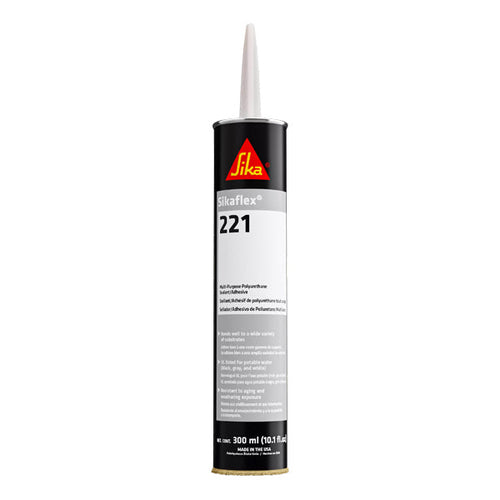
Sikaflex-221 is a one-component polyurethane adhesive sealant designed to bond and seal a variety of substrate materials, including metals, plastics, ceramics, metal primers, and paint coatings. This multipurpose adhesive sealant is great for general bonding and internal sealing applications. It can create durable and lasting bonds that are paintable and sandable for a professional finish. The Sikaflex-221 polyurethane is also non-corrosive and has a low odor. Its aluminum gray, black, and white formulations are listed under NSF/ANSI/CAN 61 for drinking-water system components.
Comparing Sikaflex-227 and Sikaflex-221
Sikaflex-227 and Sikaflex-221 are both one-component polyurethane adhesive sealants, but their varying properties make them best suited for different applications. To help you get a better understanding of which sealant is right for your application, our team reviews the key similarities and differences between the Sikaflex-227 sealant and the Sikaflex-221 sealant.
| Property | Sikaflex-227 | Sikaflex-221 |
|---|---|---|
| Chemical Base | One-component polyurethane | One-component polyurethane |
| Skin Time (CQP019-1) | ≈40 minutes | ≈60 minutes |
| Tensile Strength | 230 psi (ASTM D412) | 260 psi (CQP036-1) |
| Elongation at Break | 600% (ASTM D412) | 500% (ISO 527) |
| Density (Uncured) | 10.8 lb/gal (1.3 kg/L) | 10.8 lb/gal (1.3 kg/L) |
| Shore A Hardness (ISO 48-4) | 40 | 40 |
| Shrinkage (CQP014-1) | 5% | 5% |
| Application Temperature | 41°F to 95°F (5°C to 35°C) | 41°F to 104°F (5°C to 40°C) |
| Chemical Resistance | Generally resistant to fresh water, seawater, diluted acids, and caustic solutions | Generally resistant to fresh water, seawater, diluted acids, and caustic solutions |
| Finishing | Sandable and paintable | Sandable and paintable |
Overall, Sikaflex-227 and Sikaflex-221 have some of the same properties, including their chemical base, Shore A hardness, shrinkage, chemical resistance, and finishing capabilities. With these shared properties, they are suitable for some of the same applications. On the other hand, their differences can help you determine which product better meets your specific requirements.
One of the notable differences between the Sikaflex-227 and Sikaflex-221 polyurethane sealants is their skin times. Sikaflex-227 offers a shorter skin time, which may be beneficial for manufacturers looking to speed up production. Compared to Sikaflex-227, the Sikaflex-221adhesive sealant also has a slightly wider application temperature range. It is important to note that Sikaflex-221 has a higher reported tensile strength and a lower elongation at break, but these reported values were measured using different testing methods and are not directly comparable.
How to Choose
Seeing the differences between these products is important, but knowing how those differences affect real-world performance is essential for your adhesive selection. When picking between the Sikaflex-227 adhesive sealant and the Sikaflex-221 adhesive sealant, or any similar product, there are multiple factors to consider.
- Specific application requirements and priorities (product design, elongation at break, tensile strength, etc.)
- Substrate materials (do not ignore the manufacturer’s recommended surface preparation)
- End use (environmental conditions, regulatory requirements, etc.)
- Production processes (skin time, curing speed, finishing requirements, etc.)
- Total cost-in-use (material costs, production impact, downtime, etc.)
We always recommend trialing a new sealant and testing it under your real-world conditions to ensure it is compatible with your application.
When to Use Sikaflex-227
The Sikaflex-227 polyurethane sealant can be used for general sealing, seam sealing, and simple bonding applications. With good non-sag properties, Sikaflex-227 has the added benefit of being compatible with overhead applications as well as other challenging orientations. It also can help dampen sound and minimize vibrations.
With these properties, Sikaflex-227 is ideal for use in:
- Trailers
- Recreational vehicles
- HVAC units
- Metal buildings
When to Use Sikaflex-221
A multipurpose adhesive sealant, Sikaflex-221 can be used for general bonding and internal sealing applications. With certifications for drinking water component systems, the Sikaflex-221 polyurethane can also be used in some sensitive environments.
Some potential applications for Sikaflex-221 include:
- Assembly of trucks, trailers, marine vessels, and RVs
- Appliance assembly
- Body sealing for food-processing and vending equipment
- Metalworking
- General sealing and elastic bonding of industrial components and machinery
- Sealing awning components and joints
Ensure You Get the Right Fit
Both Sikaflex-227 and Sikaflex-221 are reliable one-component polyurethanes that are suitable for a wide range of bonding and sealing applications. Although they share some characteristics, their distinct properties make them better suited for different uses. There are also other adhesive sealants on the market that may be a good match for your application.
To ensure you find the best fit for your application, we want to help. Contact our team to speak with a sealant expert. We will discuss your application and provide you with tailored sealant recommendations that match your needs.