
Metal to Wood Adhesives
Metal to Wood Adhesives: Surface Prep & Adhesive Recommendations
Table of Contents
- Why Use Metal to Wood Adhesives
- Key Challenges
- Types of Adhesives for Bonding Metal to Wood
- How to Choose the Right Adhesive
- Surface Preparation and Priming
- FAQs
Bonding metal to wood is a common application in industrial and manufacturing environments and requires an adhesive that can accommodate the difficulties that come with bonding dissimilar materials. Our team walks you through how to choose the best metal to wood adhesives and what factors matter most in real-world applications.
Why Use Metal to Wood Adhesives
Compared to mechanical fasteners, adhesives can offer performance and process advantages for bonding metal and wood. Using adhesives for metal-to-wood bonding can help you:
- Distribute loads evenly across the entire bond area
- Reduce vibration and noise in assemblies
- Eliminate drilling into finished surfaces
- Improve aesthetics by hiding visible hardware
- Minimize galvanic corrosion risks from mixed metals
- Reduce overall assembly weight
- Streamline production
Because adhesives provide clear advantages when bonding metal to wood, they can be used in a wide range of applications. Some common uses include panel stiffeners, furniture manufacturing, and interior trim components in transportation equipment.
Key Challenges When Adhering Metal to Wood
Before you can glue wood to metal, you need to understand both substrates and the challenges that can come with trying to bond them. This is especially important in industrial or commercial applications where long-term durability and performance matter.
Finding the right adhesive for metal to wood presents a unique set of challenges. You are joining two materials that behave very differently when exposed to moisture and temperature changes. Metal is dimensionally stable under humidity changes but expands and contracts with temperature changes. On the other hand, wood can swell or shrink as humidity fluctuates. When the two materials move differently, stress can build up in the adhesive layer and weaken the bond.
Another problem when using an adhesive for wood to metal can be surface preparation. Metal parts are often covered in oils, fluids, or coatings. Wood substrates can also be covered in sanding dust, fibers, stains, or sealers. These contaminants can prevent the adhesive from properly wetting out and bonding to the substrate. Consequently, proper surface preparation is imperative for effective bonding.
Manufacturers should also pay attention to the bonding environment and production process. If you do not account for all these factors, the bond can fail.
Types of Adhesives for Bonding Metal to Wood
There is no single best adhesive for metal-to-wood bonding. Instead, the right choice depends on the specific needs of your application. Some adhesives are designed to provide maximum structural strength, while others prioritize flexibility or rapid handling. Understanding how each adhesive type behaves makes it easier to determine which option fits your application and production process.
Below, our team highlights some of the best adhesives to bond metal to wood as well as when each type is typically used and a few product recommendations to consider.
Epoxies
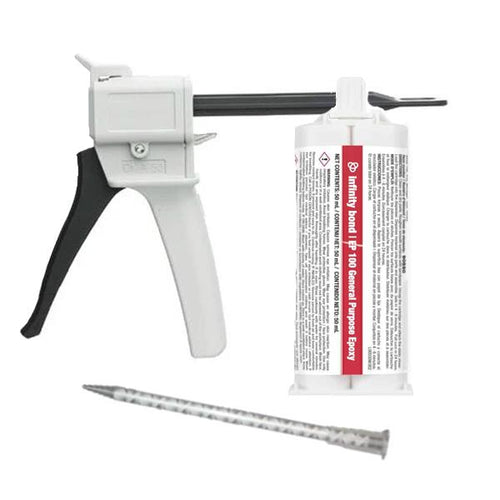
Epoxy adhesives are often chosen when maximum strength and durability are required. They offer very high bond strength along with great chemical and temperature resistance. They are also capable of filling larger gaps between substrates, which can be useful when bonding metal components to uneven wood surfaces.
The downside is that these adhesives tend to be less flexible than other adhesive types and are more rigid. Consequently, they may not be the best option for bonds that will experience a lot of movement or vibration. They are most commonly used for structural brackets, panel stiffeners, and other industrial assemblies where long-term performance is critical.
Recommended Adhesives: Infinity Bond Epoxy Adhesives, 3M Epoxy Adhesives
Acrylic Foam Tapes (VHB)
Acrylic foam tapes, such as VHB tapes, provide strong shear strength and moderate flexibility. These pressure-sensitive adhesives create a consistent bond line and require no mixing or curing time, so they can be an attractive choice for high-volume production environments.
They are commonly used for attaching trim panels, stiffeners, and other interior components where speed and clean aesthetics are important. Because tapes rely heavily on surface contact, proper surface preparation is critical for long-term performance.
Recommended Adhesives: 3M VHB tape
Cyanoacrylates
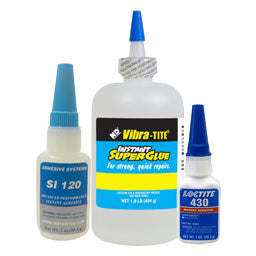
Cyanoacrylate adhesives or super glues are often used for small parts and applications that require extremely fast bonding. These adhesives cure quickly in the presence of moisture and can achieve strong bonds within seconds.
While cyanoacrylates offer moderate to high strength, they are typically brittle unless toughened formulations are used. As a result, they are best suited for small components, fast assembly tasks, or applications where the bonded joint will not experience significant movement or impact.
Recommended Adhesives: Infinity Bond Cyanoacrylate Adhesives
One-Component Polyurethanes
Another option for structural metal to wood glues is one-component polyurethanes. These adhesives provide a balance between strength and flexibility. They cure with moisture from the surrounding environment or the substrate and can accommodate movement in the bonded joint better than many rigid adhesive systems.
Because of their flexibility, they are commonly used in applications such as furniture frames, architectural panels, and other assemblies where wood movement is expected. One consideration with polyurethane adhesives is that cure speed can vary depending on humidity levels and substrate conditions.
Recommended Adhesives: Sikaflex
Reactive Polyurethane Hot Melts
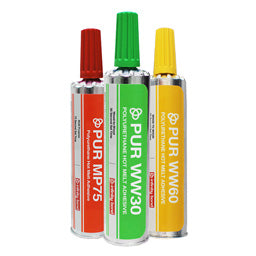
Reactive hot melt polyurethane adhesives combine fast processing with strong long-term performance. When applied, they behave like traditional hot melts and provide excellent initial tack so components can be handled quickly during production.
After application, the adhesive continues to react with moisture in the air or substrates. Over time, this reaction increases the structural strength of the bond. Because of this two-stage bonding process, these adhesives are widely used in high-speed manufacturing environments such as panel fabrication and interior trim assembly.
Recommended Adhesives: Infinity Bond PUR Hot Melt Adhesives
Thermoplastic Hot Melts (EVA, APAO, Polyamide)
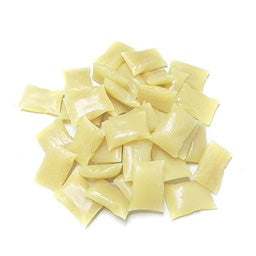
Thermoplastic hot melts such as EVA, APAO, and polyamides offer another option to glue metal to wood. These adhesives set quickly as they cool and are relatively simple to apply using bulk melters or handheld applicators.
While they may not provide the same structural strength or temperature resistance as other options like epoxies or polyurethanes, they can still deliver reliable performance in light or moderate duty applications. They are also typically more cost-effective and easier to implement, so they can be more attractive for high-volume production where extreme performance is not required.
Recommended Adhesives: IB APAOs
MS Polymers / SMP (Hybrid Adhesives)
MS polymers, also referred to as SMP or hybrid adhesives, fall into the broader category of adhesive sealants. These adhesives provide excellent flexibility and are well suited for joints that experience movement or vibration over time.
Although they generally do not match the structural strength of epoxies, they perform well in assemblies where both bonding and sealing are required. Like polyurethane adhesives, they cure through exposure to moisture in the air or substrate, so cure times can vary based on environmental conditions.
Each type of adhesive offers different benefits, so the right adhesive depends on what the application requires. Some projects demand maximum structural strength, while others prioritize flexibility, speed, or cost. To choose, the next step is to determine what factors are most relevant to your needs.
Step-by-Step: How to Choose the Right Adhesive
Selecting the right metal to wood adhesive means taking into account a number of different considerations. Our team recommends looking at the following factors to narrow down your choices and help you make an informed decision.
Define the load type
Start by understanding what type of stress the joint will be exposed to. Some bonds experience mostly shear forces, while others may see peel forces, vibration, or sudden impacts.
Evaluate the expected movement
Consider how the materials will move over time. Wood can expand and contract with humidity changes, while metal reacts more to temperature changes. If your assembly will experience these shifts, selecting an adhesive with some flexibility can help prevent long-term fatigue at the bond line.
Determine the environmental exposure
Think about where the finished product will be used. Will it be exposed to moisture, certain chemicals, outdoor environments, or elevated temperatures? Environmental conditions can significantly affect adhesive durability, so matching the adhesive to the service environment is critical.
Establish the required fixture time
Production speed often determines which adhesives are the most practical. Some structural adhesives require longer cure times. Others develop fast green strength that allows immediate handling. Understanding your acceptable fixture time can help narrow down your choices.
Identify gap size needs
In some applications, the metal and wood surfaces may not sit perfectly flush, and there are gaps at the bond line. If this is the case, you may need an adhesive with gap-filling capabilities.
Review your equipment requirements
Your existing equipment plays a major role in adhesive selection. Different chemistries may require different dispensing systems and tools. Choosing an adhesive compatible with your current setup can simplify implementation and reduce capital investment.
Once you review these factors, it becomes much easier to identify which adhesive category makes the most sense for your application. When chemistry, equipment, and workflow are all aligned, you can reduce bottlenecks and create a more reliable bonding process.
How to Glue Metal to Wood: Surface Preparation and Priming
In many cases, surface preparation can be the difference between success and failure in metal-to-wood bonding. While some adhesives have a higher tolerance for contaminants on the bonding surface, others require more extensive preparation to form a strong bond.
While this process will depend on the type of adhesive you are using, surface preparation for metal to wood bonding generally involves the following:
- Cleaning and degreasing the metal surface to remove oil and residue
- Removing dust and loose fibers from the wood
- Abrading the surface of the metal (often for epoxies or one-component polyurethanes)
- Using a primer or adhesion promoter on the metal for optimal bond strength (usually recommended for epoxies, VHB tapes, cyanoacrylates, and one-component polyurethanes)
For best results, always follow the manufacturer’s specific recommendations.
Need a Recommendation?
Bonding metal to wood with adhesives requires both selecting the right metal to wood adhesive for the job as well as applying it correctly. At Gluegun.com, we have extensive collections of adhesives for metal as well as adhesives for wood. If you want more help determining exactly which adhesive is right for you, you can reach out to our team and get a personalized product recommendation.
Related Products


Frequently Asked Questions
Epoxies generally tend to have the highest ultimate strength and perform well in structural bonding applications. You should keep in mind that the strongest option is not always the best choice to adhere metal to wood. Especially if your joint experiences movement or vibration, more flexible adhesives such as polyurethane or MS polymer adhesives are probably a better choice.
In some cases, yes. When working with tapes, cyanoacrylates, and some polyurethanes, metals may require primers or adhesion promoters to maximize bond strength. Always follow the recommendations of the adhesive manufacturer and test your specific substrate.
It depends on the application. Thermoplastic hot melts tend to work well for light-duty or controlled environments. On the other hand, polyurethane hot melts can provide stronger and more durable bonds. They are often used in higher-performance interior assemblies.
You need to select an adhesive that has a higher level of flexibility and is better suited for assemblies that experience humidity fluctuations. MS polymers and certain polyurethanes are often a good choice.
Ask a Question
Have questions? Our team of adhesive experts can help. Submit your questions and we'll get you answers right away. We're here to help.